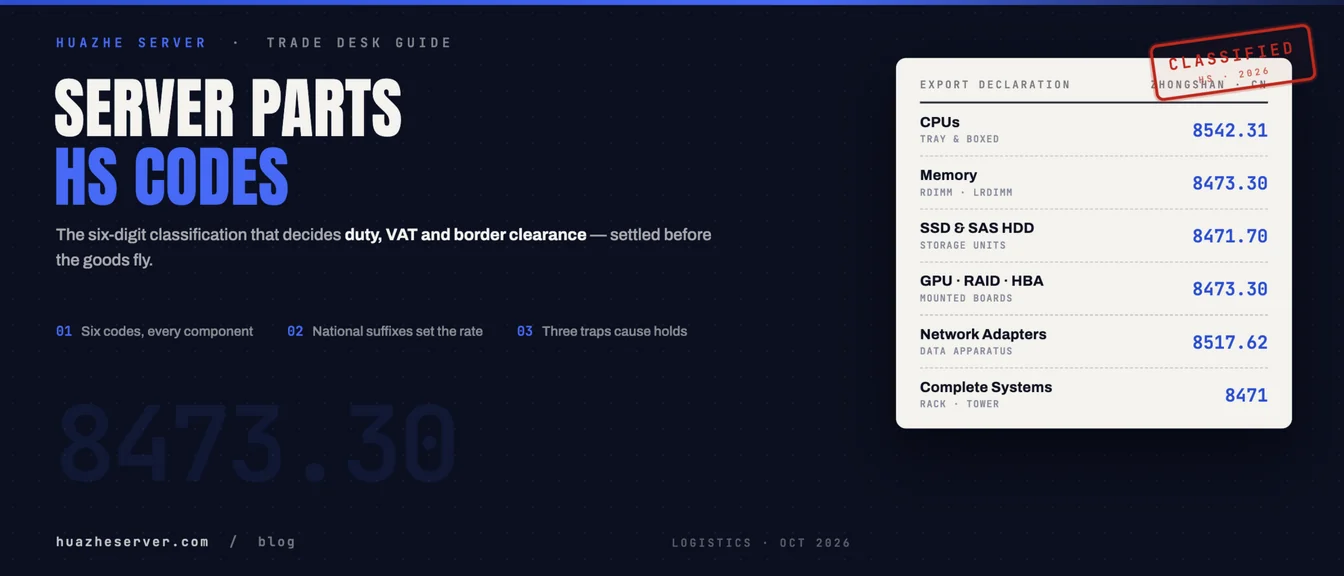
Quick answer: Six codes cover almost everything a server-parts buyer imports. Complete systems clear under 8471, CPUs under 8542.31, mounted memory and controller cards under 8473.30, enterprise SSDs and HDDs under 8471.70, and network adapters usually under 8517.62. The first six digits are the same everywhere; what you actually pay depends on your country's own suffix and whatever tariffs it stacks on Chinese origin this quarter. Classify the part in front of you, not the machine it came out of — that one habit prevents most of the overpayments and border holds we see.
The invoice says "server components, used, 40 pieces." Somewhere between the supplier's export declaration and your port of entry, a customs broker has to turn that sentence into a ten-digit code and a duty rate. Two shipments of identical hardware can clear at meaningfully different cost depending on which code wins that argument.
This guide settles the argument in advance — written from the export side of the table, for the buyers who pay the duty.
The six codes that matter
| What you're shipping | HS code | What customs actually calls it |
|---|---|---|
| Complete rack or tower servers | 8471.41 / 8471.49 / 8471.50 | Processing units of automatic data-processing (ADP) machines. A rack server with no monitor or keyboard in the housing usually lands at 8471.50 |
| CPUs, tray or boxed | 8542.31 | Processors and controllers — integrated circuits |
| Memory modules (RDIMM / LRDIMM) | 8473.30 | Parts and accessories of ADP machines. Not 8542 — see trap one |
| Enterprise SSDs and SAS HDDs | 8471.70 | Storage units of ADP machines |
| RAID / HBA cards, GPUs, motherboards | 8473.30 | Mounted circuit boards serving ADP machines |
| Network adapters | 8517.62 | Apparatus for the reception, conversion and transmission of data |
A mixed BOM — a few systems plus spares, drives plus the cards to run them — is normal for our shipments, and it means several codes on one invoice. That is fine. What is not fine is one line that says "computer parts, various," because now the broker classifies for you, in a hurry, at the port.
Six digits are global. The rest is your country's opinion.
The six-digit core — the "HS" proper — is set by the World Customs Organization and reads identically in every member country. Everything after it is national law: the United States runs ten-digit HTSUS codes, the EU an eight-digit Combined Nomenclature, India the ITC-HS. Two consequences follow.
First, duty rates attach to the national suffix, not the international core. 8473.30 tells you what the goods are; it does not tell you what Belgium charges.
Second, the code on our Chinese export declaration is not binding on your side of the ocean. It is a strong hint — our customs reviewed it before release — but your broker re-classifies under your jurisdiction's law, and occasionally disagrees. When real money rides on the answer (recurring volume, or a part that could go two ways), the settled solution is a written ruling: a Binding Tariff Information in the EU, or the published CROSS rulings in the US. Both are public documents; a broker can request the BTI, and anyone can search CROSS for how similar hardware was ruled before.
What duty actually looks like — and why we won't print a rate table
- EU and UK: computers and parts circulate at 0% conventional duty. What you pay at the door is VAT — 19–23% in most of the EU, 20% in the UK — recoverable if you are VAT-registered.
- United States: the base rates on all six codes are mostly free. What changes the bill is China-origin stacking: Section 301 lists plus the 2025 reciprocal-tariff regime. Most computer-hardware categories won exemptions in April 2025, semiconductors were treated separately, and the stacking has been revised more than once since. Any rate table printed in an article would be stale before the ink dried — get the live rate at quotation time, and expect it on the paperwork, not in the footnotes. One more US change that catches sample-buyers: the small-parcel de minimis exemption has been suspended, so even two validation CPUs now clear as formal entries.
- India: consistently among the higher-duty markets for imported IT hardware — basic customs duty plus cesses, revised budget by budget. Get the code-specific rate before you build the landed-cost model.
- GCC / UAE: 5% duty, 5% VAT. Simple, and it stays simple.
The honest summary: the code is stable, the rates are not. Budget from the classification, then confirm the number when the quotation lands.
Three traps we see most often
The memory module that ships as an integrated circuit. A bare DRAM die is 8542.32 — a "memory" in the IC heading. A mounted module — die on a PCB, with SPD and power components — is 8473.30, a computer part. The two codes sit in different chapters, and in several markets they have carried different tariff treatment for Chinese origin. If a supplier's invoice lists RDIMMs as 8542, ask the question before the goods fly, not after the hold.
The SSD that gets booked as flash storage. USB sticks and memory cards are 8523.51, "solid-state non-volatile storage devices" — the heading exists for consumer media. An enterprise U.2 NVMe or SAS drive is not that animal. It is a storage unit of an ADP machine: 8471.70. Both are flash; only one of them is computer equipment in the eyes of the tariff schedule.
The pulled card with no home. A GPU pulled from an HGX board, a PERC or HBA controller, an OEM motherboard — all still mounted boards serving ADP machines, all 8473.30, new or used. "Used parts, unspecified" is not a classification; it is an invitation for someone at the border to guess, and you are the one who pays for the guess.
One footnote on network adapters: depending on the market and its ruling history, they drift between 8517.62 and 8473.30. Pick one per destination and keep it consistent across the invoice, packing list and entry. In practice, customs officers forgive a debatable code far more readily than they forgive three documents that disagree.
The paperwork that actually clears the shipment
Classification gets the rate right; documents get the boxes released. The minimum set for a server-parts consignment:
- commercial invoice, line by line, with real part numbers — OPNs and sSpecs, not catalogue names;
- packing list with quantities that match the invoice to the piece;
- certificate of origin, and where the lane qualifies, a preference form — RCEP covers our Japan, Korea and ASEAN shipments, for example;
- a declared value that matches the invoice exactly.
On that last point, our position is unfashionable: we do not under-declare. Not because anyone enjoys paying duty, but because an invoice has to survive an audit three years later. The margin saved today becomes the shipment that gets seized, fined, or pulled for inspection on every future entry — and since insurance rides at invoice value, under-declaration also means under-insurance. The shipping guide lists the full documentation set we send with each consignment, and our FOB vs DDP explainer covers who pays which leg under each term.