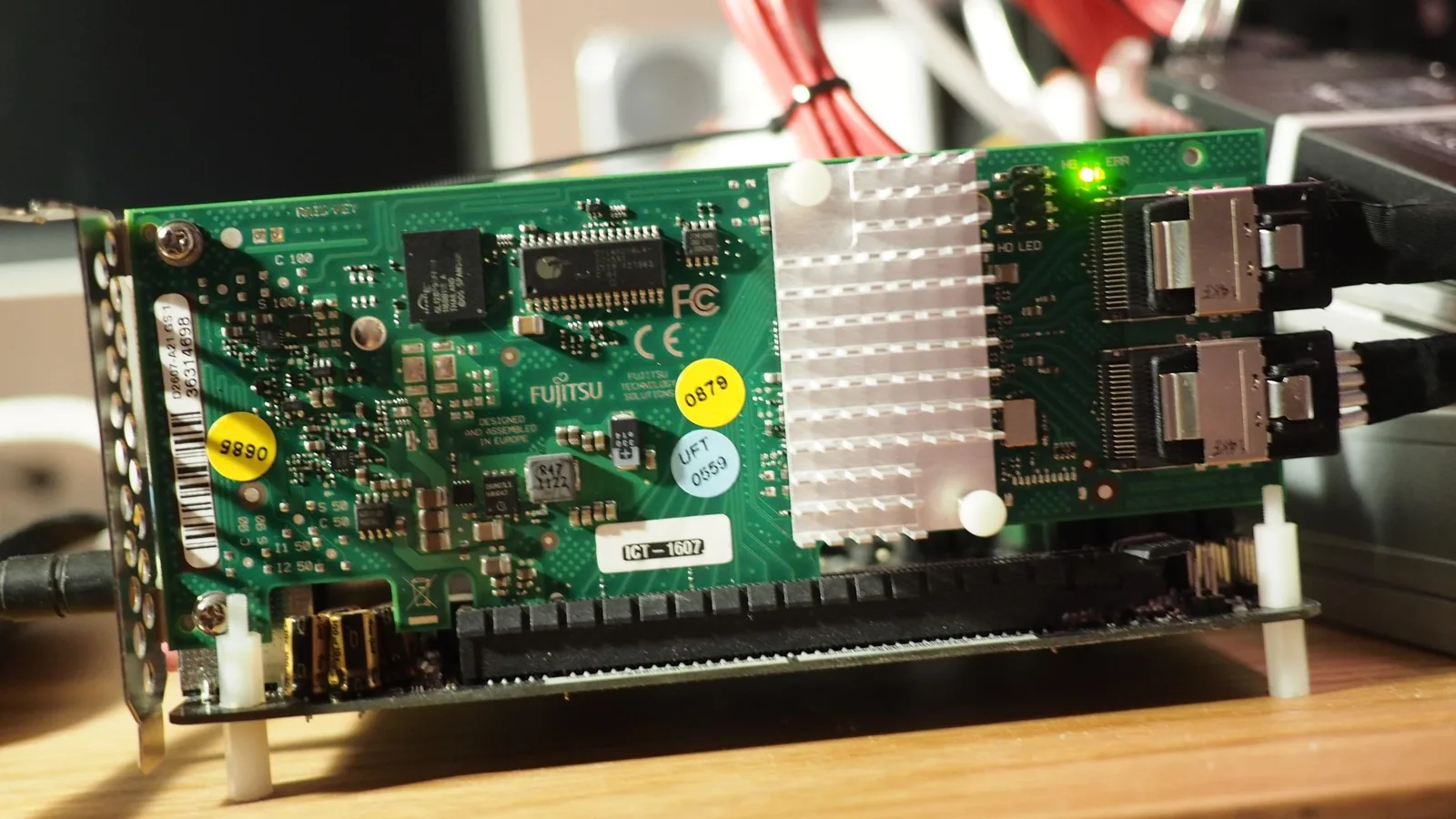
Quick answer: Choose by who owns redundancy. ZFS and Ceph need a true IT-mode HBA that passes raw disks, SMART data and flush commands straight through; VMware, Hyper-V and database arrays need hardware RAID with a healthy CacheVault or BBU behind write-back. Match the card's PCIe generation and port count to the slot and backplane, pay for 24G SAS only where the drives can use it, and on a pulled card check cache health, firmware and kit completeness before payment.
Every storage BOM has a line that says "RAID card" and a build that quietly assumes the wrong one. A cache-protected MegaRAID on a Ceph node presents virtual disks, so Ceph finds no OSDs; a bare HBA on a VMware host presents raw disks and no array. Both fit the same slot. Only one fits the workload.
Architecture first: cache-protected RAID or raw passthrough
- Hardware RAID owns redundancy. A ROC offloads parity, manages virtual drives and holds a DRAM cache. With write-back it acknowledges writes before media, and a BBU or CacheVault covers the gap on power loss. The OS sees one disk — right for VMware VMFS, Hyper-V CSV and database volumes. The cache module is not an accessory.
- An IT-mode HBA owns nothing. Firmware passes each drive through raw: no RAID metadata, no virtual disk, no hidden cache. SMART, serials and flush commands reach the OS, and redundancy moves up the stack to ZFS mirrors and raidz, or Ceph replication and erasure coding.
- Why ZFS needs it. ZFS manages vdevs, checksums, scrub and replacement by device, so it must see the physical disks. A controller hides the members: ZFS cannot heal a vdev or name the failed drive, and an unprotected write-back cache that acknowledges a sync write holds the only copy on power loss.
- Why Ceph needs it. One OSD per raw block device. BlueStore writes its own checksums and WAL, and Ceph replicates or erasure-codes above the disk. A RAID layer hides individual failures, blocks SMART prediction and makes the controller a single point of failure for every OSD behind it.
- "JBOD mode" is not IT mode. Many RAID cards expose drives as JBOD while the firmware stays RAID: metadata can persist, SMART may not pass through, and queue behaviour differs. True IT mode is a firmware personality or a dedicated model. The 9207 and 9300 are IT HBAs by design, but the same silicon ships as OEM RAID cards and older IR variants, so used cards are routinely crossflashed — trust the firmware, not the label. The 9400, 9500 and 9600 are IT by model. Do not run ZFS on RAID 0 members.
- Write-safe means cache-safe. If the workload needs hardware RAID, write-back is the performance reason and a healthy module is the safety condition. A dead module should force write-through — MegaRAID's default policy ends "No Write Cache if Bad BBU" — so verify nobody changed it. Parity RAID has a write hole; protected cache narrows it, ZFS's copy-on-write avoids it, and Ceph avoids it above the disk.
PCIe generation and port count: match the host, not the brochure
The controller cannot move more data than the slot and backplane carry. A 12G lane carries 12 Gb/s; a 4-lane SFF-8643 connector carries 48 Gb/s, about 4.8 GB/s after encoding. 24G doubles both. PCIe 3.0 x8 delivers about 7.9 GB/s and PCIe 4.0 x8 about 15.8 GB/s. A 16-port 12G card has 16 SAS lanes but only 7.9 GB/s to the host — fine, because SAS is switched and 16 HDDs never stream at full rate together. A 24G card needs PCIe 4.0 to be meaningful, which is why the 9500 and 9600 are PCIe 4.0 x8.
| Model | Host | SAS link | Internal ports | Connectors | Cache protection | Typical role |
|---|---|---|---|---|---|---|
| LSI 9207-8i | PCIe 3.0 x8 | 6G | 8 | 2× SFF-8087 | none | Low-cost IT-mode HBA for ZFS |
| LSI 9300-16i | PCIe 3.0 x8 | 12G | 16 | 4× SFF-8643 | none | Workhorse IT/IR HBA |
| Broadcom 9400-16i | PCIe 3.1 x8 | 12G | 16 | 4× SFF-8643 | none | Tri-Mode on 12G backplanes |
| Broadcom 9500-16i | PCIe 4.0 x8 | 12G | 16 | 2× SFF-8654 x8 | none | Tri-Mode, Gen4 host |
| MegaRAID 9560-16i | PCIe 4.0 x8 | 12G | 16 | 2× SFF-8654 x8 | 8 GB + CacheVault | Hardware RAID with protected write-back |
| Broadcom 9600-16i | PCIe 4.0 x8 | 24G | 16 | 2× SFF-8654 x8 | none | 24G Tri-Mode HBA |
Ports are lanes, not bays: a 16i card feeds 16 drives directly, an 8i card needs an expander for 16 bays, and a 24-bay chassis wants a 24i card or an expander sharing its uplink. Connectors are generation-bound — SFF-8643 and SFF-8654 do not interchange, so quote card and cable kit together. And x8 means x8 electrical: a physical x16 slot wired as x8 trains at x8 — fine for 12G, a waste of a 24G card.
12G vs 24G SAS: where the extra bandwidth pays
- HDD arrays do not need 24G. A 12G SAS HDD streams at 200–300 MB/s; even 24 drives behind a 12G expander are limited by the drives, not the link. 12G gear is cheaper and the supply is deeper.
- 24G pays at the flash end. 24G SAS SSDs, all-flash shelves and Tri-Mode NVMe benefit, and the headroom helps rebuilds. In a mixed SAS/SATA/NVMe chassis, Tri-Mode matters more than the link rate.
- Every link must match. A 24G HBA on a 12G backplane trains at 12G; 24G drives on a 12G expander run at 12G. 24G uses SFF-8654 on the 9500 and 9600, SFF-8643 on the 9400 and older — plan cables and backplane together.
- Backward compatibility is real, not free. 24G ports accept 12G and 6G drives at their own rate, and 24G drives fall back on 12G ports; a mixed array runs at the slowest link.
- Spend the difference where it protects data. For a 16-bay HDD ZFS box, a 12G IT-mode HBA plus a verified spare beats a 24G card that never leaves 12G.
Three checks that decide a pulled controller
New cards are a purchase order. Pulled cards are an inspection, and the failures concentrate in three places.
1. Cache-protection health
On a RAID card the cache module is the only part that genuinely wears, and a dead module is quiet: write-back may be disabled, or — if someone changed the policy — the card may keep acknowledging writes it cannot protect. On ZFS or Ceph the module is irrelevant, which is why a pulled HBA is simpler to qualify. Read it with storcli /c0/cv show all (state, temperature, capacitance) and show status; on BBU cards storcli /c0/bbu show all adds voltage, next learn cycle and remaining capacity. Accept only "Optimal" — "Failed", "Missing" or the wrong module all mean card-only pricing. BBU packs contain lithium-ion cells, so cross-border air shipments often arrive without one; CacheVault supercapacitors are not lithium and normally travel with the card.
2. Firmware identity
storcli /c0 show returns product name, serial, SAS address, firmware, NVDATA, BIOS and the OEM field — the card's passport. OEM firmware is platform-locked: Dell PERC and HPE Smart Array variants use the same silicon but update through OEM tools, so a PERC can work in a third-party board and still refuse retail firmware. Quote it to its platform, or not at all. "IT mode" must be firmware, not a setting: on older LSI cards it is a crossflash — verify with sas2flash -list on the 9207 and sas3flash -list on the 9300 and later, and check for foreign configuration; on the 9400, 9500 and 9600 it is the HBA model. Unify the batch: one firmware and NVDATA pair per order.
3. Bracket, cables and the rest of the kit
Full-height and low-profile brackets are different parts; a 2U chassis needs the low-profile one, and pulls often arrive with only the full-height. SFF-8643 for 12G and SFF-8654 for 24G do not interchange, and 4i and 8i cables carry different lane counts — the cable is part of the bill of materials. The CacheVault module may mount remotely and connect by cable; without both the card has no protection, so ask for a photo of the module connected to the exact card. These are passive, full-length cards: they need server airflow and chassis depth.
"A pulled RAID card is not one product. It is a card, a cache module, a bracket and a cable kit — and most listings price only the first one."
— Huazhe incoming-inspection procedure
Condition grades: new, pulled and refurbished
| Grade | What it is | Verify before paying | Best for | Price vs new |
|---|---|---|---|---|
| New — boxed | Distribution or factory stock with full warranty | Warranty registration, complete accessory kit, correct OEM or retail variant | Production arrays, support contracts | Reference |
| Pulled & tested | Decommissioned pulls, reflashed and burn-tested | CacheVault/BBU state per card, FW/NVDATA/BIOS and OEM field, bracket and cable photos, no foreign config | Expansions, secondary sites, ZFS/Ceph nodes | Typically 40–60% below |
| Refurbished | Third-party rework | Module health disclosure, DOA window, no reflow or repair marks | Labs, spare pools, test benches | Typically 50–70% below |
For ZFS and Ceph, a pulled IT-mode HBA is usually the best-value line in the bill of materials: there is no cache module to age and no RAID metadata to clean. For a production hardware-RAID array, the cache module is the one line item worth buying new.